



Commercial disputes can create serious challenges for businesses, especially when disagreements arise over unpaid invoices, contractual obligations, partnership arrangements or service agreements. Taking every disagreement directly to court may increase the time, expense and pressure involved in resolving a business matter.
In India, the Commercial Courts Act, 2015 provides a mechanism known as Pre-Institution Mediation under Section 12A. It gives eligible parties an opportunity to attempt settlement before filing a commercial suit, where the law requires this process.
For businesses, understanding this procedure can help them make informed decisions when a commercial dispute arises.
Quick Answer: What Is Pre-Institution Mediation?
Pre-Institution Mediation is a dispute resolution process that takes place before filing certain commercial cases in court. Under Section 12A of the Commercial Courts Act, 2015, a plaintiff must generally exhaust this mediation process before instituting a commercial suit that does not contemplate urgent interim relief.
The process is intended to help parties explore a mutually acceptable settlement with the assistance of an authorized mediation authority. If mediation does not result in a settlement, the party may proceed with the legal remedy available under applicable law.
What Is Pre-Institution Mediation in Commercial Disputes?
Pre-Institution Mediation is a formal process through which parties attempt to resolve a commercial dispute before approaching a Commercial Court.
Section 12A of the Commercial Courts Act, 2015 deals with this requirement. It applies to commercial suits of the specified value that do not contemplate urgent interim relief. In such cases, the plaintiff is required to exhaust the pre-institution mediation remedy before filing the suit.
Commercial disputes may involve matters such as:
- Disagreements arising from business contracts
- Unpaid amounts for goods or services
- Distribution and supply agreements
- Partnership and joint venture disagreements
- Construction and infrastructure contracts
- Business service and consultancy agreements
- Other disputes covered by the definition of commercial dispute under the Act
Not every disagreement between businesses automatically qualifies. The nature of the dispute, its specified value and the applicable legal requirements must be examined.
When Is Pre-Institution Mediation Required?
Pre-Institution Mediation is generally mandatory when a proposed commercial suit:
- Falls within the definition of a commercial dispute under the Commercial Courts Act, 2015.
- Meets the applicable specified-value requirement.
- Does not contemplate urgent interim relief.
The specified value under the Act is generally not less than ₹3 lakh, or such higher value as may be notified by the Central Government or applicable State notification.
If a case genuinely requires urgent interim relief, the statutory exception may apply. Whether the exception is available depends on the facts and relief sought in the case.
Businesses should therefore assess the nature of their dispute before deciding whether mediation is required.
How Does the Pre-Institution Mediation Process Work?
The process is conducted through an authority authorised for this purpose. The following steps provide a general overview.
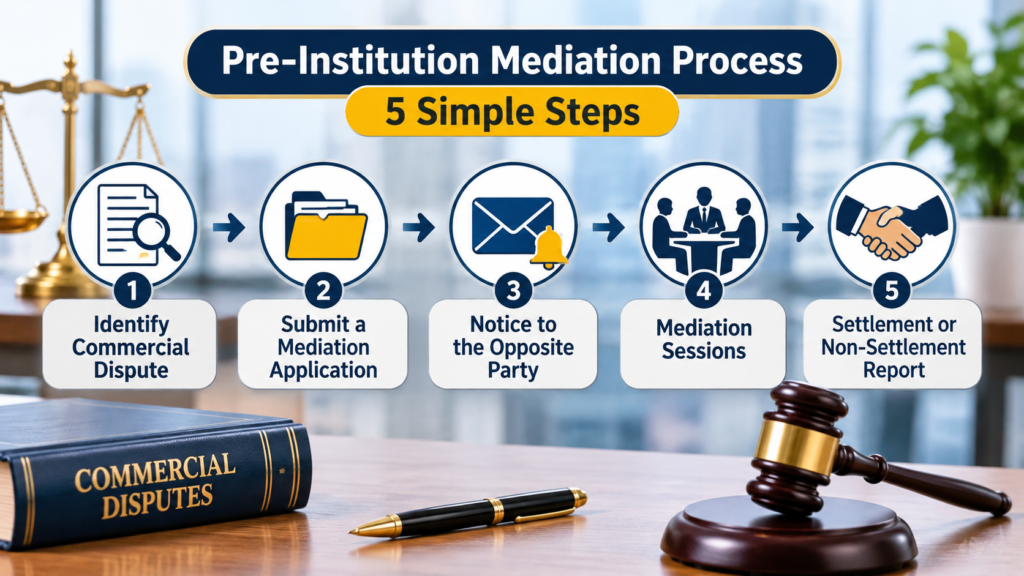
1. Identify the Commercial Dispute
The first step is to understand the nature of the disagreement. The parties should identify the relevant agreement, transaction, unpaid amount or contractual obligation involved.
It is also important to check whether the dispute falls within the definition of a commercial dispute and meets the applicable specified-value requirement.
2. Submit a Mediation Application
The party seeking mediation can approach the authorised authority by submitting the prescribed application and relevant details.
The application generally includes information about the parties, the nature of the dispute and the relief or settlement being sought. Supporting documents may also be required.
3. Notice to the Opposite Party
After receiving the application, the authority follows the prescribed procedure for notifying the opposite party and inviting participation in the mediation process.
The opposite party gets an opportunity to respond and participate in discussions.
4. Mediation Sessions
A mediator facilitates communication between the parties and helps them explore possible settlement terms.
The parties may discuss their concerns, exchange proposals and consider practical solutions. The mediator assists the discussion but does not impose a decision on either party.
5. Settlement or Non-Settlement Report
If both parties reach an agreement, the settlement is recorded in writing and signed in accordance with the applicable legal requirements.
If no settlement is reached, or the mediation cannot proceed, the authority issues the appropriate report under the prescribed procedure. The applicant may then consider the available legal remedies.
How Long Does Pre-Institution Mediation Take?
Under Section 12A of the Commercial Courts Act, 2015, the mediation process is generally required to be completed within three months from the date of the application.
This period may be extended by a further two months with the consent of the parties.
The time spent in pre-institution mediation is excluded when calculating the limitation period under the Limitation Act, 1963, as provided by Section 12A.
The actual duration may depend on the nature of the dispute, participation of the parties and the progress of discussions.
Benefits of Pre-Institution Mediation for Businesses
Pre-Institution Mediation can provide businesses with an opportunity to explore settlement before entering into formal court proceedings.
Opportunity to Resolve Disputes Early
Businesses can attempt to resolve disagreements before they develop into lengthy legal proceedings. Early discussions may help preserve business relationships where both parties are willing to cooperate.
Reduced Litigation Burden
A mutually acceptable settlement may help parties avoid the additional time and effort involved in pursuing a commercial suit.
Flexible Settlement Discussions
Unlike a court decision, mediation allows parties to discuss practical settlement options based on their business requirements. The final terms depend on mutual agreement.
Better Communication Between Parties
A mediator facilitates structured discussions and gives both sides an opportunity to explain their concerns. This may help identify the actual issues behind the disagreement.
Opportunity to Protect Business Relationships
Where the parties want to continue working together, mediation can provide a structured way to address disagreements without immediately escalating the matter into litigation.
However, mediation does not guarantee settlement. Its success depends on the willingness of the parties to participate and reach an agreement.
What Documents Should Businesses Keep Ready?

Proper documentation can help parties explain their position during mediation.
Depending on the nature of the dispute, useful documents may include:
- Business agreements and contracts
- Purchase orders and invoices
- Payment receipts and transaction records
- Emails and written communication
- Delivery challans and service records
- Account statements and outstanding payment details
- Previous settlement proposals or legal notices
- Documents supporting the claim or response
Businesses should organise these records before initiating the process. Complete and consistent documentation can make discussions more focused.
What Happens If Pre-Institution Mediation Fails?
Mediation may not always result in an agreement. Sometimes, the parties may disagree on the amount payable, contractual responsibility or proposed settlement terms.
If the mediation process does not result in settlement, the applicant may pursue the appropriate legal remedy, including filing a commercial suit where the legal requirements are satisfied.
The failure of mediation does not automatically mean that the applicant has lost the right to approach the court. The next step depends on the facts, applicable limitation period and procedural requirements.
Businesses should review the mediation outcome and supporting documents before taking further legal action.
Mediation vs. Litigation: Understanding the Difference
| Basis | Mediation | Litigation |
| Process | Facilitated settlement discussions | Formal court proceedings |
| Decision | Parties decide whether to settle | Court decides the dispute |
| Participation | Depends on the parties’ cooperation | Parties participate through the legal process |
| Outcome | Mutually agreed settlement, if successful | Court judgment or order |
| Purpose | Attempt to resolve the dispute through settlement | Obtain a legally binding judicial determination |
Both mechanisms have their own role. The appropriate approach depends on the dispute, urgency, available evidence and the relief required.
When Should a Business Seek Legal Guidance?
Businesses should consider obtaining legal guidance when a commercial disagreement involves significant financial exposure, disputed contractual terms, repeated payment defaults or the possibility of court proceedings.
A legal professional can help assess whether the dispute falls within Section 12A, whether pre-institution mediation is required, what documents should be prepared and what options may be available if settlement is unsuccessful.
Businesses dealing with contractual disagreements, payment disputes or other commercial matters can also explore litigation-related legal assistance to understand the available legal procedures and next steps.
Frequently Asked Questions
1. Is Pre-Institution Mediation mandatory in commercial disputes?
It is generally mandatory for commercial suits covered by Section 12A of the Commercial Courts Act, 2015, where the suit does not contemplate urgent interim relief. The applicable specified-value and other statutory requirements must also be satisfied.
2. Which law governs Pre-Institution Mediation in India?
Section 12A of the Commercial Courts Act, 2015 provides for Pre-Institution Mediation and Settlement in qualifying commercial disputes. The applicable rules prescribe the procedure.
3. What is the minimum specified value for commercial disputes?
The specified value under the Commercial Courts Act, 2015 is generally not less than ₹3 lakh, or a higher amount if notified by the Central Government or applicable State notification.
4. How much time is allowed for Pre-Institution Mediation?
The statutory period under Section 12A is generally three months from the date of application. It can be extended by a further two months with the consent of the parties.
5. Can a business approach the court if mediation fails?
Yes. If mediation does not result in settlement, the applicant may pursue the appropriate legal remedy, subject to applicable procedural and limitation requirements.
6. Does a mediator decide who is right or wrong?
No. A mediator facilitates communication and settlement discussions. The mediator does not impose a judgment or force either party to accept a settlement.
7. Does every business dispute require Pre-Institution Mediation?
No. The requirement applies to qualifying commercial suits under Section 12A. The nature of the dispute, specified value and urgent interim relief exception must be considered.
Conclusion
Pre-Institution Mediation provides businesses with an opportunity to address qualifying commercial disputes before approaching a Commercial Court. It encourages structured discussions, gives parties a chance to explore settlement and may reduce the need for formal litigation when an agreement is reached.
Businesses should understand the applicable legal requirements, maintain proper records and assess their available options before initiating or responding to a commercial dispute. Taking timely legal guidance can help them choose an appropriate course of action based on the facts of the matter.