


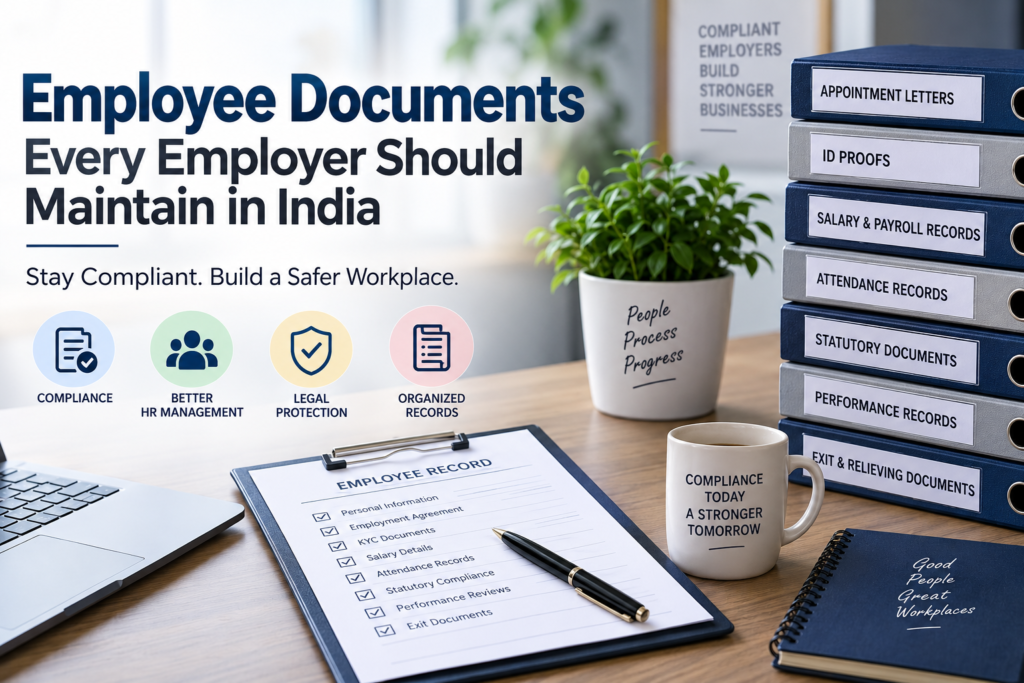
An employee joins your company, HR collects a few documents, payroll starts, and everyone moves on to the next task. Months later, you may need to find an appointment letter, wage record, attendance details, leave record, or statutory documAn employee joins your company, HR collects a few documents, payroll starts, and everyone moves on to the next task. Six months later, someone needs the appointment letter, salary record, attendance details, leave history, or a statutory document—and suddenly nobody is quite sure where it is, whether it was updated, or whether the company was actually required to maintain it.
This is why understanding the employee documents required by law in India is not just an HR paperwork exercise. Proper employee documentation helps employers establish employment terms, maintain accurate payroll and attendance records, demonstrate statutory compliance, and respond more confidently to audits, inspections, employee disputes, and other legal requirements.
Since India’s Labour Codes came into effect from 21 November 2025, employers also need to understand the updated framework for employment records, registers and wage-related documentation. The Ministry of Labour & Employment has specifically highlighted requirements relating to appointment letters and maintenance of prescribed records.
But there is an important catch: there is no single employee-document checklist that applies identically to every employer in India. Requirements can vary depending on the establishment, state, industry, workforce, category of employees, and the laws and rules applicable to that business.
So, instead of asking only, “What documents should HR collect?”, it is better to ask:
What records does our business need to create, maintain, update and preserve throughout the employee lifecycle?
This guide breaks that question down practically.
Quick Answer: What Employee Documents Should Employers Maintain?
In general, employers may need to maintain records covering:
- Employment and appointment details
- Employee identification and personal information
- Salary and wage records
- Wage slips
- Attendance and working-hour records
- Overtime records
- Leave records
- Statutory deductions
- Applicable PF and ESI records
- Other social-security records
- Workplace or safety-related records, where applicable
- Employee changes such as salary revisions and transfers
- Resignation, termination and full-and-final settlement records
However, not every document on this list is mandatory for every employer or every employee.
The exact requirements should be determined according to the establishment and the laws applicable to it.
Under the current wage framework, for example, prescribed employer records include attendance-cum-muster rolls, wage registers, overtime registers and records of fines and deductions. The Ministry’s current compliance handbook states that these records should be kept updated, may be maintained electronically or physically, and are to be preserved for five years.
That distinction—between a general HR document and a legally prescribed record—is important.
What Employee Documents Are Required by Law in India?
There is no universal folder that every Indian employer can create and assume that its compliance work is finished.
The documents required depend on questions such as:
- What type of establishment is it?
- Where is the establishment located?
- How many people does it employ?
- What type of workers does it engage?
- Which industry does it operate in?
- Does it employ contract labour?
- Which social-security laws apply?
- Which state-specific employment requirements apply?
- Are there special workplace or safety requirements?
For example, the current regulatory framework specifically provides for records relating to employees, attendance, wages, overtime and deductions. The applicable rules also provide for electronic or physical maintenance of prescribed registers and their production before an Inspector-cum-Facilitator when required.
That is why a good employee-documentation system should be built around categories, rather than one generic list copied from another company.
1. Employment and Appointment Documents
The first group of documents establishes the basic relationship between the employer and employee.
These may include:
- Appointment letter
- Employment agreement, where applicable
- Offer letter or joining documentation
- Designation and role details
- Compensation details
- Employment start date
- Applicable terms and conditions
- Relevant declarations and acknowledgements
- Nomination-related documentation, where applicable
Why Is the Appointment Letter Important?
The appointment letter is not simply an HR formality.
It creates a written record of important employment terms and can help avoid confusion about matters such as:
- Designation
- Salary
- Place of work
- Date of joining
- Working conditions
- Notice requirements
- Benefits
- Other applicable employment terms
The Ministry of Labour & Employment has highlighted the provision for mandatory appointment letters under the Labour Codes as part of formalising employment relationships.
The practical point for an employer is simple:
Do not issue an appointment letter and then forget about it.
If material employment terms change later, the relevant documentation should also be updated or supplemented appropriately.
2. Employee Identification and Personal Records
Employers also maintain information that allows them to identify and administer an employee’s employment relationship.
Depending on the circumstances and applicable requirements, this may include:
- Employee name
- Contact details
- Address
- Identification information
- Date of birth or age-related information where relevant
- Bank/payroll information
- Nomination details
- Applicable statutory identification numbers
- Emergency contact information
- Other information legitimately required for employment administration
The important point here is data minimisation.
An employer should not collect every piece of personal information simply because it might be useful someday.
The information collected should have a legitimate employment, payroll, statutory or business purpose, and access should be appropriately controlled.
3. Payroll and Wage Records
If there is one area where poor documentation can quickly become a serious problem, it is payroll.
Employers should maintain appropriate records relating to:
- Salary or wages
- Wage period
- Basic pay and applicable components
- Deductions
- Overtime
- Advances
- Applicable fines
- Wage slips
- Other prescribed wage-related information
The Code on Wages framework provides for prescribed wage and attendance records, while the Ministry’s compliance handbook specifically identifies wage registers, overtime registers and registers relating to fines and deductions.
👉Code on Wages, 2019
Why Payroll Documentation Matters
Imagine an employee disputes the salary paid six months ago.
Without proper records, HR may have to reconstruct:
- What the agreed salary was
- How many days the employee worked
- What deductions were made
- Whether overtime was paid
- Whether any advance was recovered
- Whether the employee received the applicable wage slip
Good payroll documentation turns that dispute from a memory problem into an evidence-based review.
4. Wage Slips and Salary Statements
A wage slip is one of the most practical documents in the employment relationship because it gives the employee a record of the wages paid and relevant deductions.
The Ministry’s current compliance handbook states that employers must issue wage slips in the prescribed form to employees on or before payment of wages.
Employers should therefore make sure that wage-slip processes are aligned with payroll records.
A common problem is having:
HR salary record → one figure
Payroll system → another figure
Wage slip → another figure
That kind of inconsistency creates unnecessary compliance risk.
5. Attendance and Working-Hour Records
Attendance records are not merely useful for calculating salary.
They can also become important when dealing with:
- Working hours
- Overtime
- Weekly offs
- Leave
- Wage disputes
- Employee grievances
- Statutory compliance
Depending on the establishment, records may include:
- Attendance register
- Muster roll
- Digital attendance
- Shift records
- Working hours
- Overtime hours
- Weekly-off records
- Other prescribed attendance information
The current rules provide for an attendance-cum-muster roll and prescribed records concerning employees, wages, overtime and deductions.
A practical rule for HR
Your attendance system and payroll system should tell the same story.
If attendance says one thing and payroll says another, you have a documentation problem even if both systems individually appear complete.
6. Overtime Records
Overtime is another area where documentation matters.
Where applicable, employers should maintain records showing:
- Employee working overtime
- Date or period
- Number of overtime hours
- Applicable rate
- Overtime payment
The current wage framework recognises overtime records as part of prescribed employer records. The Ministry’s compliance handbook also states that where the applicable minimum wage provisions apply, overtime for work beyond normal working hours is payable at not less than twice the normal wage.
Employers should therefore avoid relying on informal WhatsApp messages, spreadsheets maintained by individual managers, or verbal approvals as the sole overtime record.
7. Leave and Holiday Records
Leave records are another area where small administrative gaps can become difficult to resolve later.
Depending on the applicable requirements, an employer may maintain:
- Leave applications
- Leave approvals
- Leave balances
- Leave taken
- Leave wages where applicable
- Holiday records
- Attendance-linked leave information
The exact leave documentation will depend on the employment framework applicable to the establishment.
Why should leave and attendance match?
Suppose an employee is shown as absent in the attendance system but approved for leave in the HR system.
Or the HR system says an employee had 12 days of leave available, while payroll shows a different figure.
These may appear like minor administrative issues until they become part of an employee dispute or compliance review.
8. Statutory Employee Records
The phrase statutory employee records sounds complicated, but the basic idea is straightforward.
These are records that an employer is required to maintain because a particular law or rule requires them.
Depending on the business and applicable legislation, these may cover:
- Employees and workers
- Attendance
- Wages
- Overtime
- Deductions
- Leave
- Social-security contributions
- Employee identification
- Workplace incidents
- Prescribed returns
- Other statutory information
The Code on Social Security framework also contains provisions concerning records and registers relating to persons employed, muster rolls, wages, working days, working hours, leave, overtime, attendance and other prescribed particulars.
The Occupational Safety, Health and Working Conditions framework also provides for maintenance and production of prescribed registers, records and returns.
This is why employers should avoid assuming that an ordinary HR employee file is automatically the same thing as a statutory compliance record.
They overlap—but they are not always identical.
Employee Documents Checklist for Employers
A practical employee documents checklist can be divided into the following categories.
| Category | Examples | Main Purpose |
|---|---|---|
| Employment | Appointment letter, employment agreement | Establish employment terms |
| Employee information | Identification, address, contact details | Employee administration |
| Payroll | Wage/salary records | Payroll compliance |
| Wage slips | Periodic wage slips | Record of payment |
| Attendance | Attendance register, muster roll | Working-hour records |
| Overtime | Overtime records | Record additional working hours |
| Leave | Leave applications and records | Leave administration |
| Statutory | Applicable registers and records | Legal compliance |
| Social security | Applicable PF, ESI and other records | Statutory benefits |
| Deductions | Deduction and advance records | Payroll transparency |
| Workplace incidents | Applicable accident/safety records | Safety compliance |
| Exit | Resignation, settlement and separation records | Employment closure |
Important: This is a practical framework, not a universal legal checklist. Employers should verify which documents and registers actually apply to their establishment.
Employee Records Employers Must Maintain Throughout the Employee Lifecycle
A common mistake is to think about employee records only at the time of joining.
In reality, employee documentation follows the entire employment lifecycle.
Before Joining
The employer should identify what documentation will be required before onboarding.
This can include:
- Employment terms
- Designation
- Compensation
- Employee identification information
- Applicable statutory information
- Required declarations
At Joining
The employee’s file should be created and the required employment documentation should be completed.
This can include:
- Appointment letter
- Employment agreement, where applicable
- Joining documents
- Applicable statutory forms
- Nomination information
- Policy acknowledgements
During Employment
Records may need to be updated for:
- Salary revisions
- Promotions
- Transfers
- Changes in designation
- Attendance
- Overtime
- Leave
- Statutory deductions
- Social-security contributions
- Other material employment changes
At Exit
The documentation process should continue until the employment relationship is properly closed.
Relevant records may include:
- Resignation
- Termination documentation
- Notice-period records
- Full-and-final settlement
- Outstanding payments
- Experience/relieving documentation
- Applicable statutory exit records
This lifecycle approach is much more reliable than maintaining one static “employee file”.
Employee Documentation in India: What Should Be Collected at Joining?
When a new employee joins, HR should ideally ask three questions.
1. Who is the employee?
Collect the information genuinely required to identify and administer the employment relationship.
2. What are the employment terms?
The appointment/employment documentation should establish relevant terms such as designation, compensation, joining date and applicable conditions.
3. What statutory requirements apply?
This is where businesses often make mistakes.
Not every employee has exactly the same statutory documentation requirements. Applicability can depend on the establishment, employee category and applicable law.
So instead of creating one enormous onboarding checklist, businesses should create a core onboarding checklist + applicable statutory checklist.
That approach is both cleaner and easier to maintain.
What Employee Documents Should Be Updated During Employment?
Creating the employee file is only the first step.
A good HR documentation system should have a mechanism for identifying when an employee’s information changes.
For example:
Salary Change
Update the relevant employment and payroll documentation.
Promotion
Update designation and other relevant employment records.
Transfer
Record the applicable change in location, department or role.
Change in Employee Information
Update relevant records when legitimately required information changes.
Statutory Changes
Update applicable statutory records and information as required.
The basic principle is:
If the employment relationship changes materially, ask whether the documentation should change with it.
How Long Should Employers Keep Employee Records?
This is one of the questions HR teams frequently get wrong.
There is no single retention period for every employee document.
Different records can have different statutory retention requirements.
For example, the current Ministry compliance handbook states that specified wage-related registers—including attendance-cum-muster roll, wage register, overtime register and register of fines and deductions—are to be preserved for five years.
The current rules also state that specified registers and records under the relevant framework are to be preserved in original for five calendar years from the date of the last entry.
But that does not mean an employer should simply delete every employee document after five years.
Other considerations may include:
- Another applicable law
- Tax requirements
- Contractual obligations
- Pending disputes
- Litigation
- Internal business requirements
- Other statutory retention periods
Better approach
Create a document retention matrix.
For example:
| Record Category | Retention Approach |
|---|---|
| Wage records | Follow applicable statutory requirement |
| Attendance records | Follow applicable statutory requirement |
| PF/ESI records | Follow applicable requirements |
| Employment contracts | Follow legal/business retention policy |
| Exit documents | Consider statutory + dispute/litigation needs |
| Workplace records | Follow applicable safety/employment requirements |
This is much safer than having one arbitrary “delete after X years” rule for everything.
What Happens If Employee Records Are Not Properly Maintained?
The consequences are not limited to government penalties.
Poor documentation can create problems in everyday business operations.
For example, an employer may struggle to answer:
- What salary was agreed?
- What salary was actually paid?
- What deductions were made?
- How many hours did the employee work?
- Was overtime recorded?
- What leave was approved?
- Which statutory contributions were made?
- What employment terms were accepted?
- What happened when the employee left?
If the records are incomplete, the employer may have difficulty demonstrating what actually happened.
Current rules also provide for production of prescribed records before an Inspector-cum-Facilitator or authorised authority when required.
So the real value of employee documentation is not merely:
“We have paperwork.”
It is:
“We can demonstrate what happened.”
That is a much stronger compliance position.
Common Employee Documentation Mistakes Employers Make
1. Collecting Documents Once and Never Updating Them
An employee’s salary, designation, location or other relevant information can change.
A six-month-old employee file may no longer accurately reflect the current employment relationship.
2. Keeping HR and Payroll Data Separate
If HR says one salary and payroll shows another, someone will eventually have to explain the difference.
HR, attendance and payroll systems should be reconciled regularly.
3. Treating a Generic Internet Checklist as Legal Advice
This is particularly risky.
A checklist written for a manufacturing unit in one state may not apply to a small office in another.
The correct question is not:
“What documents does every Indian company need?”
It is:
“Which documents and records apply to our establishment and employees?”
4. Assuming Digital Storage Automatically Solves Compliance
Digital records are convenient, but they still need:
- Access control
- Backups
- Accuracy
- Version management
- Security
- Proper organisation
- Retrieval capability
A folder full of poorly named PDFs is not a compliance system.
5. Ignoring State-Specific Requirements
Employment and labour compliance can involve both central and state-level requirements.
Employers should therefore verify state-specific applicability instead of copying another company’s documentation process.
6. Forgetting About Exit Records
The employee leaves and HR closes the laptop.
That’s not the end of the documentation requirement.
Resignation, termination, settlement and other relevant exit records may become important much later if a dispute arises.
7. Maintaining Records but Not Reviewing Them
Having documents is not enough.
A company may have 100% of its employee files and still have compliance gaps because:
- Records are outdated
- Information conflicts
- Required registers are missing
- Statutory records are incomplete
- Documents cannot be quickly retrieved
A periodic review is therefore more useful than simply collecting more paperwork.
Digital vs Physical Employee Records: Which Is Better?
Modern employers increasingly use digital HR systems, but the question should not be reduced to “paper or software”.
The current framework expressly permits certain prescribed registers and records to be maintained electronically or physically.
| Digital Records | Physical Records |
|---|---|
| Easy to search | Useful where physical records are required |
| Easier to back up | Physical audit trail |
| Easier access control | Requires secure storage |
| Scales well for larger teams | Can become difficult to manage |
| Easier reporting | Risk of physical damage/loss |
For a digital employee-record system, focus on:
- Secure access
- Regular backups
- Role-based permissions
- Consistent file naming
- Clear folder structure
- Change/version tracking
- Easy retrieval
- Appropriate retention
The real test is simple:
Can an authorised person find the correct record quickly and demonstrate that it is accurate?
How Should an Employer Organise Employee Documents?
A simple structure can make HR documentation considerably easier.
Folder 01 — Employment
- Appointment letter
- Employment agreement
- Joining documentation
Folder 02 — Employee Information
- Identification information
- Contact information
- Relevant declarations
Folder 03 — Payroll
- Salary records
- Wage slips
- Deductions
- Advances
- Overtime
Folder 04 — Attendance & Leave
- Attendance
- Working hours
- Leave
- Weekly offs where applicable
Folder 05 — Statutory Compliance
- Applicable statutory records
- PF/ESI records where applicable
- Required registers
- Compliance documentation
Folder 06 — Employment Changes
- Salary revisions
- Promotions
- Transfers
- Designation changes
Folder 07 — Exit
- Resignation/termination
- Notice-period records
- Full-and-final settlement
- Experience/relieving documents
This structure can be adapted to the business. The important thing is consistency.
How to Prepare Employee Records for a Labour Law Audit
A labour-law audit should not begin when someone sends an inspection notice.
Businesses can periodically review their documentation using a simple process.
Step 1: Create an Employee Master List
Know exactly who is currently employed and which categories of workers are engaged.
Step 2: Check Employment Documentation
Confirm that relevant appointment/employment documents are available.
Step 3: Reconcile Payroll and Attendance
Check whether salary, attendance, overtime and leave records are consistent.
Step 4: Review Statutory Records
Identify which registers, returns and records apply to the establishment.
Step 5: Check Missing Documents
Create a gap list instead of trying to fix everything randomly.
Step 6: Check Retention
Identify whether records are being preserved for the applicable period.
Step 7: Check Retrieval
Ask someone who did not create the system to find a sample employee’s records.
If they cannot find them quickly, the system needs improvement.
Employee Documentation Audit Checklist
Before considering the documentation system complete, an employer can ask:
Employment
- Do we have appropriate appointment/employment documentation?
- Are employment terms accurately recorded?
- Are material changes documented?
Payroll
- Are wage records complete?
- Are wage slips issued as required?
- Are deductions properly recorded?
- Are overtime records maintained where applicable?
Attendance
- Is attendance recorded?
- Are working hours identifiable?
- Is overtime supported by records?
Leave
- Are leave applications and approvals recorded?
- Do leave records reconcile with attendance?
Statutory Compliance
- Have we identified applicable statutory requirements?
- Are prescribed registers maintained?
- Are applicable PF/ESI and other social-security records maintained?
Exit
- Are resignation/termination records maintained?
- Is full-and-final settlement documented?
- Are relevant exit records retained?
Retention
- Do we know the retention requirement for each major record category?
- Can we retrieve historical records when required?
If several answers are “not sure,” the business should treat that as a compliance-review trigger.
What Changed With the Labour Codes for Employer Record-Keeping?
The Labour Codes have made it even more important for employers to understand their record-keeping responsibilities instead of relying on scattered legacy checklists.
The current framework includes prescribed registers and records for areas such as:
- Employees
- Attendance
- Wages
- Overtime
- Deductions
- Other employment-related particulars
For example, the current rules provide for an employee register, attendance-cum-muster roll, and wage/overtime/deduction records, with electronic or physical maintenance and prescribed preservation requirements.
The Ministry’s compliance handbook similarly identifies attendance-cum-muster rolls, wage registers, overtime registers and registers of fines and deductions, and states that these should be kept updated and preserved for five years.
This means businesses should not assume that an old HR checklist automatically reflects the current framework.
At the same time, employers should avoid the opposite mistake of assuming that one national checklist answers every compliance question.
The applicable establishment-specific rules still matter.
When Should a Business Seek Professional Labour Law Guidance?
If you are reading this and realising that your company has:
- Incomplete employee files
- Different salary records in different systems
- Unclear statutory applicability
- Missing registers
- Uncertain retention periods
- Poor documentation of employment changes
- No formal compliance-review process
then simply downloading another HR checklist may not solve the problem.
The real question is:
Which requirements actually apply to your business, and are your current records sufficient to demonstrate compliance?
This is where professional legal guidance can be useful.
Businesses that need help reviewing their employment documentation, statutory requirements, compliance gaps and broader labour-law obligations can explore Labour Law Advisory Services.
The objective should not be to create paperwork for the sake of paperwork. It should be to identify the requirements that apply to the business and build a compliance system that HR can realistically maintain.
Labour Law Compliance Review: Questions Every Employer Should Ask
Before assuming that the company is fully compliant, ask:
- Do we know which labour and employment laws apply to our establishment?
- Do we have the required employment documentation for our employees?
- Are our payroll, attendance, overtime and leave records consistent?
- Are prescribed registers being maintained in the required form?
- Are statutory records updated?
- Can we produce relevant records when required?
- Are we following applicable retention requirements?
- Are state-specific requirements being considered?
- Do we review compliance periodically?
- Who is responsible for identifying and closing documentation gaps?
If the business cannot confidently answer these questions, a professional compliance review may be more useful than simply adding another HR template.
You can also explore our labour-law compliance support for assistance with reviewing applicable employment and labour-law requirements.
Frequently Asked Questions
What employee documents are required by law in India?
The requirements depend on the establishment, workforce, industry and applicable laws. Common categories include appointment and employment documents, employee details, wage and payroll records, attendance, working hours, leave and applicable statutory records.
Is an appointment letter mandatory for employees in India?
The Ministry of Labour & Employment has stated that the Labour Codes provide for mandatory issue of appointment letters to workers/employees. The precise implementation and applicable requirements should be checked against the relevant law and rules for the establishment.
What employee records must an employer maintain?
Depending on applicability, records can include employee registers, attendance/muster rolls, wage and overtime records, deductions, leave, employee identification details and other prescribed statutory record
How long should employee records be kept?
There is no single retention period for every employee document. Different records can have different statutory requirements. For example, specified registers under the Code on Wages rules are to be preserved for five years after the last entry.
Are PF and ESI records required for every employee?
Not necessarily. PF, ESI and other social-security requirements depend on the applicable law, establishment and employee circumstances. Employers should determine applicability rather than assuming that the same requirements apply to every employee.
Should employee records be maintained digitally or physically?
Certain current labour rules expressly allow specified registers and records to be maintained electronically or physically. The important issue is whether the records are accurate, complete, up to date, secure and capable of being produced when required.
Do employee documentation requirements vary by state?
Yes. Employers may need to consider both central and state-level requirements, depending on the establishment and applicable legislation. A checklist prepared for one state or industry should not automatically be treated as universally applicable.
What documents should an employer collect when hiring a new employee?
A typical onboarding process may include employment and appointment documentation, employee identification and contact information, payroll details, applicable statutory information and relevant declarations or acknowledgements. The exact documents should be determined based on the employment relationship and applicable requirements.
Final Employee Documentation Checklist
Before closing the employee-documentation process, an employer should be able to answer yes to the relevant questions below:
Employment
- Appointment/employment documentation is available
- Employment terms are accurately recorded
- Material changes are documented
Employee Information
- Relevant employee information is recorded
- Information is updated when necessary
- Access to personal information is controlled
Payroll
- Wage/salary records are maintained
- Wage slips are issued as required
- Deductions are properly recorded
- Overtime is documented where applicable
Attendance & Leave
- Attendance is recorded
- Working hours can be established
- Overtime can be verified
- Leave records are maintained
Statutory Compliance
- Applicable statutory requirements have been identified
- Prescribed registers are maintained
- Applicable social-security records are maintained
- Records can be produced when required
Exit
- Resignation/termination documentation is maintained
- Full-and-final settlement is documented
- Relevant exit records are preserved
Retention
- Retention requirements have been identified
- Historical records can be retrieved
- Records are not deleted arbitrarily
Key Takeaway
Employee documentation in India is not simply about creating a folder for every person who joins the company.
A properly managed documentation system should follow the employee through the entire lifecycle—from appointment and onboarding to payroll, attendance, leave, statutory compliance, employment changes and eventual exit.
The most important point is that employee documents required by law in India are not identical for every business. Applicability depends on the establishment, workforce, industry, location and the laws and rules that govern the employment relationship.
The best approach is therefore not to collect every possible document.
It is to identify which records apply to your business, maintain them accurately, keep them updated, preserve them for the required period, and make sure they can be produced when needed.
Good employee records do more than satisfy a compliance checklist.
They give an employer evidence of what was agreed, what was paid, what was recorded and what actually happened.