

Labour law compliance is an important responsibility for employers in India. Businesses may need to comply with requirements relating to wages, employee records, working conditions, social security, workplace safety, leave, employment documentation, and other applicable labour regulations.
In 2026, employers should maintain a structured compliance system rather than checking requirements only when a notice or inspection arises. The Ministry of Labour and Employment’s 2026 Compliance Handbook organizes employer responsibilities into foundational, monthly, periodical or annual, and event-based compliance activities.
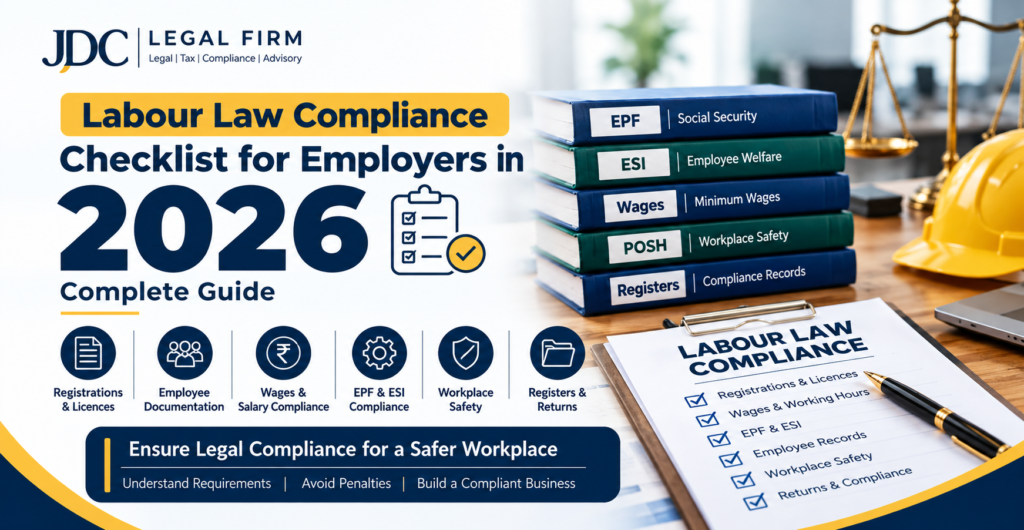
This guide explains the Labour Law Compliance Checklist for Employers in 2026, including employee documentation, wages, EPF, ESI, registers, workplace requirements, annual compliance, and important event-based obligations.
Quick Answer: What Is Included in a Labour Law Compliance Checklist for Employers in 2026?
A practical labour law compliance checklist should cover:
- Establishment registration and applicable licences
- Appointment letters for employees
- Wage and salary compliance
- Minimum wage requirements
- Working hours and rest intervals
- Overtime records and payments
- EPF compliance, where applicable
- ESI compliance, where applicable
- Wage slips and employee records
- Attendance and leave records
- Workplace safety and welfare measures
- Grievance redressal requirements
- POSH compliance, where applicable
- Maternity-related requirements, where applicable
- Statutory registers and records
- Periodic and annual returns
- Accident and incident reporting
- Final settlement and employee exit compliance
The exact requirements depend on the employer’s industry, workforce, establishment type, location, and the labour laws applicable to that organization.
What Is Labour Law Compliance?
Labour law compliance means following the employment, wage, social security, workplace safety, welfare, and other labour-related requirements applicable to an employer.
The purpose of labour compliance is not only to avoid penalties. It also helps employers maintain proper employee records, provide statutory benefits, establish fair workplace practices, and meet legal obligations.
Because labour requirements can vary between establishments, employers should determine which laws and rules apply to their particular business before preparing a compliance calendar.
Labour Law Compliance Checklist for Employers
1. Establishment Registration and Licences
The first step is to determine whether the establishment requires registration, licence, or other approval under applicable central or state labour regulations.
Employers should check:
- Establishment registration
- Applicable labour licences
- Factory-related permissions, where applicable
- Contract labour requirements, where applicable
- Shops and commercial establishment requirements
- Other industry-specific registrations
The Ministry’s 2026 handbook identifies registration and applicable licences as foundational compliance actions for employers.
2. Appointment Letters
Employers should ensure that employees receive appropriate employment documentation.
An appointment letter can clearly establish important terms such as:
- Designation
- Date of joining
- Salary or wages
- Employment conditions
- Working hours
- Leave provisions
- Notice requirements
- Other applicable terms
The 2026 Labour Ministry handbook specifically includes issuing an appointment letter to every new recruit as an event-based compliance action.
3. Wage and Salary Compliance
Employers should ensure that wages are paid according to applicable legal requirements and within the prescribed timelines.
Businesses should regularly review:
- Wage rates
- Salary structure
- Minimum wage applicability
- Wage period
- Deductions
- Overtime payments
- Wage slips
- Payment records
The Ministry’s handbook lists timely wage payment and maintenance of wage-related records among the core employer compliance activities.
4. Minimum Wage Compliance
Employers should check the minimum wage rates applicable to their employees based on the relevant employment category, location, and applicable government notifications.
Minimum wage rates can change, so employers should periodically verify whether revised rates apply to their workforce.
Payroll systems should be updated whenever applicable wage rates change.
5. Working Hours and Overtime
Employers should maintain appropriate records relating to working hours, attendance, rest intervals, weekly holidays, and overtime.
Where overtime is applicable, employers should calculate and pay it according to the applicable legal requirements.
The Ministry’s earlier employer guidance also emphasizes weekly holidays, rest intervals, working conditions, and overtime requirements.
6. EPF Compliance
Employers should determine whether their establishment and employees fall within the applicable EPF coverage requirements.
The Ministry’s 2026 handbook states that the relevant EPF provisions apply to establishments employing 20 or more employees, subject to the applicable framework.
Where EPF applies, employers should monitor:
- EPF registration
- Employee enrolment
- Employer and employee contributions
- Monthly contribution process
- Employee UAN-related records
- ECR-related compliance
- Payment records
- Employee nomination and other applicable requirements
Employers should verify current EPFO requirements rather than relying on outdated thresholds or procedures.
Employers should determine whether their establishment and employees fall within the applicable EPF coverage requirements. For current employer-related EPF services, registration facilities, contribution processes and compliance updates, employers can refer to the official Employees’ Provident Fund Organisation (EPFO) portal.
7. ESI Compliance
Employers should determine whether ESI coverage applies to their establishment and eligible employees.
Where applicable, employers should monitor:
- ESI registration
- Employee eligibility
- Contribution calculations
- Contribution payments
- Employee records
- ESI-related documentation
- Applicable returns or reporting
EPFO’s employer portal also provides access to common registration facilities for EPFO and ESIC-related processes.
8. Employee Records and Registers
Proper record maintenance is an important part of labour compliance.
Depending on the applicable rules, employers may need to maintain records relating to:
- Employee details
- Attendance
- Wages
- Deductions
- Overtime
- Leave
- Employment information
- Social security
- Other statutory requirements
The 2026 Labour Ministry handbook specifically identifies attendance, wages, deductions, and overtime records among basic employer registers.
9. Wage Slips
Employers should provide wage or salary slips as required under the applicable legal framework.
Payroll records should be consistent with:
- Salary structure
- Attendance
- Deductions
- Overtime
- Statutory contributions
- Net salary paid
Maintaining consistent payroll documentation helps reduce discrepancies during employee queries, audits, or regulatory checks.
10. Workplace Health, Safety and Welfare
Employers should assess workplace health and safety requirements applicable to their establishment.
Depending on the workplace and industry, this may involve:
- Safety measures
- Health facilities
- Welfare facilities
- Emergency procedures
- Safety equipment
- Workplace inspections
- Accident reporting
- Employee awareness
Factories, construction establishments, mines, and other higher-risk workplaces may have additional requirements.
POSH Compliance for Employers
The Prevention of Sexual Harassment of Women at Workplace framework can create specific responsibilities for covered employers.
Where applicable, employers should review:
- Workplace POSH policy
- Internal Committee requirements
- Employee awareness
- Complaint-handling procedures
- Required notices and information
- Annual reporting requirements
Employers should ensure that POSH compliance is treated as an ongoing workplace responsibility rather than only a documentation exercise.
Maternity Benefit Compliance
Employers should understand the maternity-related protections applicable to eligible employees.
Depending on the circumstances, compliance may involve:
- Maternity benefits
- Leave requirements
- Appropriate workplace arrangements
- Protection against prohibited employment actions
- Required records and documentation
Employers should review the applicable legal provisions before making decisions concerning eligible employees.
Grievance Redressal
Employers should establish appropriate mechanisms for addressing workplace grievances where required.
A structured grievance process can help employees raise workplace concerns and allow the employer to document and address complaints systematically.
The Ministry’s 2026 handbook identifies grievance redressal arrangements among foundational employer compliance measures.
Monthly Labour Compliance Checklist
Employers should consider reviewing the following every month:
- Salary and wage payments
- Attendance records
- Overtime records
- Wage slips
- EPF contributions, where applicable
- ESI contributions, where applicable
- Employee additions and exits
- Payroll deductions
- Employee records
- Applicable registers
- Compliance deadlines
The Ministry’s 2026 handbook specifically lists timely wage payment, EPF/ESIC contribution deposits, wage slips, and updating registers as monthly compliance actions.
Annual and Periodic Labour Compliance Checklist
Depending on the applicable laws and establishment, employers should review:
- Annual returns
- Labour registers
- Applicable licences
- Minimum wage revisions
- Workplace safety requirements
- Statutory records
- POSH-related annual requirements
- Other periodic reporting obligations
The Ministry’s 2026 handbook includes a Unified Annual Return, review of revised minimum wage rates, licence renewals, and applicable safety audits among periodical or annual compliance actions.
Event-Based Labour Compliance
Some labour compliance obligations arise when specific events occur.
Employers should have processes for:
New Employee Joining
- Issue appointment documentation
- Complete required employee records
- Assess EPF/ESI applicability
- Add employee to payroll
- Complete required statutory registrations or declarations
Employee Exit
Employers should calculate and settle applicable final dues and complete required exit formalities.
The Ministry’s 2026 handbook specifically identifies settlement of final dues on exit as an event-based compliance requirement.
Workplace Accident
Where applicable, employers should report accidents, dangerous occurrences, or occupational diseases within the prescribed timeframe.
The Ministry’s 2026 handbook identifies immediate reporting requirements, including specified 24–72 hour timelines depending on the event and applicable framework.
What Documents Should Employers Maintain?
A practical labour compliance file may include:
- Employee master data
- Appointment letters
- Employment agreements
- Attendance records
- Wage and payroll records
- Wage slips
- Overtime records
- Leave records
- EPF records
- ESI records
- Statutory registers
- Labour licences
- Workplace policies
- Safety records
- Grievance records
- POSH documentation, where applicable
- Exit and final settlement records
The exact documents required depend on the employer and applicable laws.
Common Labour Compliance Mistakes
Employers commonly face compliance problems because of:
- Missing employee documentation
- Incorrect wage calculations
- Outdated minimum wage rates
- Delayed statutory payments
- Incomplete registers
- Incorrect employee classification
- Missing appointment letters
- Poor attendance records
- Failure to update employee exits
- Ignoring workplace complaints
- Not monitoring regulatory changes
A centralized compliance calendar can help businesses track recurring and event-based obligations.
Labour Law Compliance Calendar for Employers
A simple compliance calendar can be divided into four categories:
| Frequency | Key Areas |
| Day One | Registration, licences, notices, registers, appointment letters |
| Monthly | Wages, EPF/ESI, wage slips, attendance and registers |
| Annual/Periodic | Returns, licence renewal, wage review, safety checks |
| Event-Based | Joining, exit, accidents, maternity, disputes and other applicable events |
This structure is aligned with the practical compliance framework outlined by the Ministry of Labour and Employment’s 2026 handbook.
How Can Employers Improve Labour Law Compliance?
Employers can strengthen their compliance process by:
- Identifying the laws applicable to the establishment.
- Maintaining an updated employee database.
- Creating monthly and annual compliance calendars.
- Reviewing wage rates periodically.
- Reconciling payroll with statutory records.
- Monitoring EPF and ESI requirements.
- Maintaining required registers and documents.
- Updating policies when regulations change.
- Recording employee grievances and resolutions.
- Taking professional legal advice when the matter is complex.
For businesses that need professional assistance with employment regulations, compliance reviews, notices, and labour-related legal matters, Labour Law Advisory Services can provide structured legal support.
Why Is Labour Law Compliance Important in 2026?
The labour compliance framework is continuing to evolve. The Ministry of Labour and Employment’s 2026 handbook explains the government’s consolidation of 29 central labour laws into four Labour Codes and describes a simplified compliance architecture involving fewer forms, registers and returns under the new framework.
However, employers should not assume that every business has identical compliance obligations. Applicability can depend on the establishment, workforce, industry, state rules, and specific circumstances.
Therefore, employers should verify the current requirements applicable to their business before making compliance decisions.
Frequently Asked Questions
What is labour law compliance?
Labour law compliance means following the employment, wage, social security, workplace safety, welfare, and other labour-related requirements applicable to an employer.
What is the most important labour compliance for employers?
There is no single requirement applicable to every employer. Common areas include employee documentation, wages, attendance, EPF, ESI, working hours, statutory records, workplace safety, and applicable returns.
Is an appointment letter mandatory for employees?
The applicable requirement depends on the relevant legal framework and establishment. The Ministry’s 2026 Compliance Handbook includes issuing an appointment letter to every new recruit as an event-based employer compliance action.
What records should employers maintain?
Depending on applicability, employers may need records relating to employees, attendance, wages, deductions, overtime, leave, EPF, ESI, safety, and other statutory requirements.
Does every employer have to register for EPF?
No. EPF applicability depends on the establishment and applicable provisions. The Ministry’s 2026 handbook identifies establishments employing 20 or more employees within the stated EPF coverage framework, subject to applicable provisions.
Does every employer need ESI registration?
ESI applicability depends on the establishment, employee coverage, wage limits and other applicable conditions. Employers should verify the current ESIC requirements for their specific situation.
What happens if labour compliance is ignored?
Non-compliance can lead to notices, financial liabilities, disputes, penalties or other legal consequences depending on the specific violation. The exact consequence depends on the applicable law and circumstances.
How often should employers review labour compliance?
A practical approach is to review compliance monthly, annually or periodically, and whenever an event such as employee joining, exit, workplace accident, regulatory change or other relevant event occurs.
Conclusion
Labour law compliance should be treated as an ongoing business responsibility rather than a one-time activity. Employers need to monitor employee documentation, wages, working conditions, social security, statutory records, workplace safety, and other requirements applicable to their establishment.
The Labour Law Compliance Checklist for Employers in 2026 should therefore include foundational, monthly, annual or periodic, and event-based checks. Because applicability varies between businesses, employers should verify the current legal requirements relevant to their establishment and seek professional advice where necessary.
A properly maintained compliance calendar, accurate employee records, timely statutory payments, and regular legal review can help employers manage labour-related responsibilities in a more organized manner.