


Managing accounting internally can become difficult as a business grows. More customers, employees, suppliers, invoices and financial transactions mean more records to maintain and more time spent on routine accounting work.
For many small and medium-sized businesses, maintaining a complete in-house accounting team may not be practical. Outsourced accounting services provide an alternative by allowing businesses to assign routine accounting and bookkeeping responsibilities to an external professional team. Businesses looking for professional support with bookkeeping, financial reporting and day-to-day financial record management can also explore Accounting Services in Patna.
From maintaining books and reconciling accounts to preparing financial reports, outsourced accounting can help businesses keep their financial records organised while allowing management to focus on operations and growth.
This approach is relevant to businesses across India, including companies and SMEs operating in Chhattisgarh, Uttar Pradesh, Madhya Pradesh, Jharkhand, Bihar and other regions.
Quick Answer: What are outsourced accounting services?
Outsourced accounting services allow businesses to hire an external accounting professional or firm to manage functions such as bookkeeping, bank reconciliation, accounts payable and receivable, financial reporting, and MIS reporting. They can help small and medium-sized businesses maintain accurate financial records without the cost of maintaining a complete in-house accounting team.
Table of Contents
What Are Outsourcing Accounting Services?
Outsourced accounting services involve engaging an external accounting professional or firm to manage selected or complete accounting functions for a business.
The exact scope depends on the business’s requirements, but may include:
- Day-to-day bookkeeping
- Recording sales and purchases
- Accounts payable management
- Accounts receivable management
- Bank reconciliation
- Ledger maintenance
- Expense recording and categorisation
- Financial statement preparation
- Monthly financial reporting
- MIS reporting
- Payroll accounting
- Accounting software management
- Financial data organisation
A business does not necessarily have to outsource its entire finance function. It can outsource specific accounting activities while retaining financial approvals and strategic decisions internally.
Why Are Businesses Choosing Accounting Outsourcing?
Accounting often starts as a relatively simple administrative task. As transaction volumes increase, however, maintaining accurate records becomes more time-consuming.
A growing business may need to manage:
- Hundreds of sales and purchase transactions
- Customer invoices and outstanding payments
- Supplier bills and payments
- Bank transactions
- Employee-related expenses
- Multiple business accounts
- Monthly financial reports
- Increasing documentation
Managing all of this without a structured accounting process can result in delayed bookkeeping, inaccurate records and limited financial visibility.
Accounting outsourcing services allow businesses to bring professional support into their financial operations without necessarily building a large internal accounting department.
What Do Outsourcing Accounting Services Include?
The services provided by an accounting firm depend on the business’s size, industry and requirements.
Bookkeeping and Financial Record Maintenance
Bookkeeping is the foundation of an organised accounting system.
It involves recording and categorising financial transactions such as:
- Sales
- Purchases
- Expenses
- Receipts
- Payments
- Bank transactions
- Business assets and liabilities
Regular bookkeeping helps ensure that financial information remains current rather than being accumulated and processed at the end of a long period.
Accounts Payable Management
Accounts payable refers to amounts the business owes to suppliers and other parties.
Accounting support can help businesses maintain records of:
- Supplier invoices
- Outstanding bills
- Payment status
- Due amounts
- Vendor balances
This gives management better visibility into short-term payment obligations.
Accounts Receivable Management
Accounts receivable represents money owed to the business by customers.
Proper records can help businesses track:
- Customer invoices
- Outstanding balances
- Payment history
- Overdue amounts
- Customer-wise receivables
This can be particularly important for businesses that operate on credit.
Bank Reconciliation
Bank reconciliation involves comparing the company’s accounting records with its bank statements.
Regular reconciliation can help identify:
- Missing transactions
- Duplicate entries
- Incorrect amounts
- Unrecorded bank charges
- Timing differences
- Unexplained discrepancies
It is an important part of maintaining reliable financial records.
Financial Reporting
Businesses need more than transaction records. Management also needs to understand what those numbers mean for the business.
Depending on the service arrangement, an outsourced accounting team may prepare reports such as:
- Profit and loss statements
- Balance sheets
- Cash flow reports
- Accounts receivable reports
- Accounts payable reports
- Expense reports
- Monthly financial summaries
These reports can help business owners understand financial performance and identify areas that require attention.
MIS Reporting
Growing businesses may also require Management Information System (MIS) reports to track business performance.
An MIS report can be designed around the information management actually needs, such as:
- Sales performance
- Outstanding receivables
- Expenses
- Branch performance
- Product or project performance
- Cash position
- Monthly profitability
The purpose is to turn accounting data into information that supports business decisions.
Payroll Accounting
Businesses with employees also need accurate records related to salaries, employee expenses and payroll-related accounting entries.
Payroll accounting can be integrated with the broader bookkeeping and financial reporting process, depending on the scope of the engagement.
Benefits of Outsourcing Accounting for Small Businesses
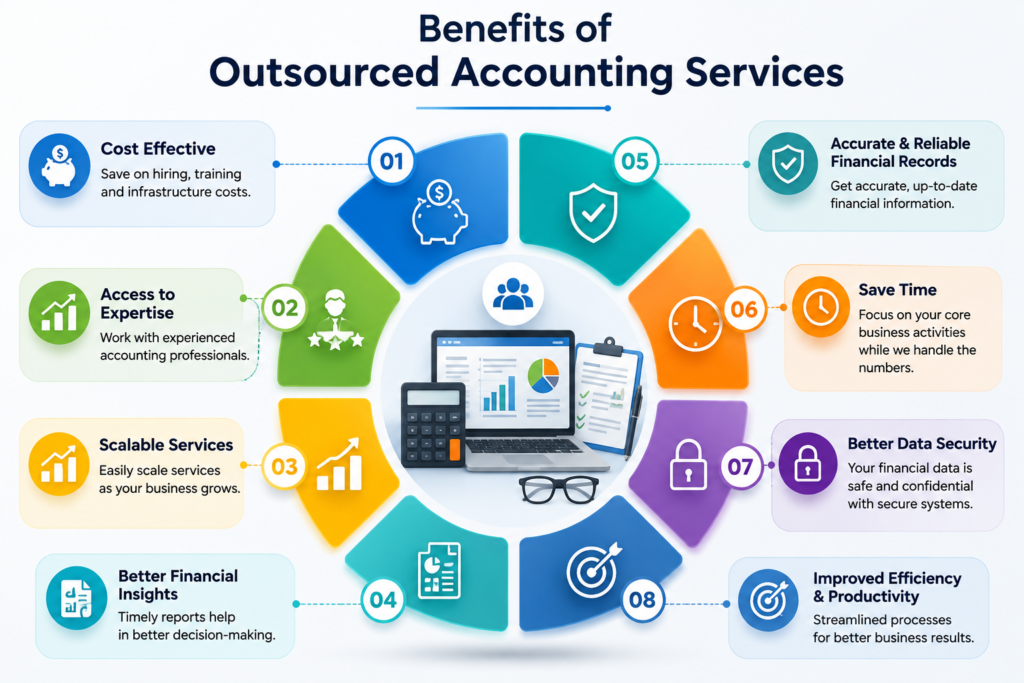
1. Access to Professional Accounting Support
A small business may not need a large finance department but may still require experienced accounting support.
Outsourcing can give the business access to accounting professionals without requiring it to build an entire internal team.
2. Reduced Administrative Burden
Business owners often end up spending time checking invoices, recording expenses, following up on financial records and dealing with accounting queries.
Delegating routine accounting work can reduce this administrative burden.
The management team can spend more time on:
- Sales
- Customers
- Operations
- Business development
- Hiring
- Expansion
- Strategic planning
3. Better Financial Visibility
When bookkeeping is updated regularly, business owners can get a clearer picture of revenue, expenses, receivables, payables and profitability.
This is particularly useful when management needs to make decisions about hiring, expansion, purchasing or cash management.
4. More Consistent Bookkeeping
Accounting problems often arise when bookkeeping is performed irregularly.
Maintaining financial records through a defined process can reduce the likelihood of incomplete or disorganised records.
Consistency is especially important for businesses with a growing number of transactions.
5. Scalable Accounting Support
Accounting requirements change as a business grows.
A small business may initially require basic bookkeeping. Later, it may need detailed financial reporting, MIS reports, payroll accounting or more structured receivables and payables management.
Outsourced accounting can be adjusted according to these changing requirements.
6. Potentially Lower Overhead Than a Full Internal Team
Hiring an internal finance team involves salaries and other employment-related costs.
Depending on the scope of work, outsourcing may allow a business to access accounting support without maintaining the same internal staffing structure.
However, outsourcing is not automatically cheaper in every situation. The right comparison should consider the business’s transaction volume, complexity and required level of accounting support.
Outsourcing Accounting vs In-House Accounting
Both approaches can work. The better option depends on the business.
| Factor | In-House Accounting | Outsourcing Accounting |
|---|---|---|
| Accounting staff | Employees hired directly | External accounting professionals |
| Cost structure | Salary and employment overhead | Service-based cost |
| Scalability | Additional hiring may be required | Scope can generally be adjusted |
| Expertise | Depends on internal team | Access to external professionals |
| Management control | Direct internal supervision | Managed through agreed processes |
| Infrastructure | Business manages internal setup | Provider manages service infrastructure |
| Suitable for | Businesses needing substantial internal finance operations | Businesses seeking flexible accounting support |
Large businesses with complex financial operations may require a dedicated internal finance department.
For many small and medium-sized businesses, however, outsourcing selected accounting functions can provide greater flexibility.
When Should a Business Consider Outsourcing Accounting?
There is no specific revenue level at which every business should outsource its accounting.
Instead, businesses should look at their actual requirements.
Outsourced accounting may be worth considering when:
- Bookkeeping is frequently delayed
- Financial records are difficult to maintain
- The business owner is handling accounting personally
- The existing accountant is overloaded
- The business is expanding rapidly
- Monthly financial reports are not available
- Receivables and payables are difficult to track
- The company operates from multiple locations
- Accounting requirements are becoming more complex
- Hiring a complete internal finance team is not practical
The real question is whether accounting is taking resources away from activities that contribute directly to business growth.
Which Businesses Can Use Outsourcing Accounting Services?
Outsourced accounting is not limited to one particular industry.
Depending on their requirements, businesses in sectors such as the following may use external accounting support:
Trading Businesses
Businesses dealing with regular purchases and sales can benefit from organised bookkeeping, inventory-related accounting records and receivables and payables tracking.
Manufacturing Businesses
Manufacturers may have more complex accounting requirements involving purchases, production costs, expenses, suppliers and financial reporting.
Professional Service Businesses
Consultancies, agencies and professional firms often need structured expense, revenue and client billing records.
E-Commerce Businesses
Online businesses may deal with large numbers of transactions, payment gateways, refunds, marketplace settlements and customer receivables.
Retail Businesses
Retail businesses can benefit from regular bookkeeping and financial reporting to understand sales, expenses and profitability.
The appropriate accounting process should always be based on the business’s actual transaction structure rather than using the same approach for every industry.
Outsourcing Accounting Services Across India
Businesses no longer need to be located in a major metropolitan area to work with an external accounting team.
Professional Outsourcing accounting services for small businesses can support companies across different parts of India, subject to their accounting requirements and the provider’s service capabilities.
This includes businesses operating in:
- Chhattisgarh
- Uttar Pradesh
- Madhya Pradesh
- Jharkhand
- Bihar
- Delhi NCR
- Maharashtra
- Gujarat
- Rajasthan
- Other parts of India
For businesses in growing commercial centres such as Raipur, Lucknow, Bhopal, Ranchi and Patna, outsourced accounting can be an option when the business needs professional financial support without establishing a large internal finance department.
How to Choose an Outsourcing Accounting Service Provider
Choosing an accounting provider should not be based only on price.
Businesses should evaluate several factors before handing over financial records.
Experience and Expertise
Check whether the provider has experience working with businesses of similar size and industry.
Service Scope
Understand exactly what is included in the engagement.
For example, does it include bookkeeping only, or does it also cover reconciliations, financial reporting, MIS reporting and payroll accounting?
Accounting Software
Check whether the provider can work with the accounting software already used by the business.
Data Security
Accounting records contain confidential financial information. Businesses should understand how data is stored, accessed and protected.
Reporting Frequency
Clarify how often financial reports will be shared and how discrepancies or accounting queries will be handled.
Communication and Responsibility
A clear process should define:
- Who provides financial documents
- Who records transactions
- Who reviews accounts
- Who approves payments
- Who handles queries
- Who prepares reports
Clear responsibilities reduce confusion between the business and the accounting service provider.
Is Outsourcing Accounting Right for Your Business?
Outsourcing accounting is not simply a way to reduce accounting costs.
The larger objective is to establish a reliable financial management process that keeps records organised and gives management timely information.
A business may benefit from outsourcing when it needs professional bookkeeping and accounting support but does not need, or cannot justify, a large internal accounting department.
The right arrangement depends on the company’s size, transaction volume, industry, reporting requirements and growth plans.
Frequently Asked Questions
What are outsourced accounting services?
Outsourced accounting services involve engaging an external accounting professional or firm to manage some or all accounting activities of a business, including bookkeeping, reconciliations, accounts payable, accounts receivable and financial reporting.
What is outsourced bookkeeping?
Outsourced bookkeeping involves hiring an external professional or firm to maintain a business’s financial transaction records instead of handling all bookkeeping activities internally.
Are outsourced accounting services suitable for small businesses?
Yes. Outsourced accounting services for small businesses can be useful when the business needs professional accounting support but does not require a full-time internal finance department.
What is the difference between bookkeeping and accounting?
Bookkeeping primarily involves recording and organising financial transactions. Accounting involves using that financial information to prepare reports, analyse performance and support financial decision-making.
Can a business outsource only bookkeeping?
Yes. A business can outsource only bookkeeping or combine it with services such as bank reconciliation, accounts payable, accounts receivable, financial reporting or MIS reporting.
Is outsourced accounting better than hiring an accountant?
Neither option is universally better. The right choice depends on the business’s size, transaction volume, complexity, budget and need for internal financial staff.
Conclusion
As businesses grow, maintaining accurate financial records becomes increasingly important. Bookkeeping, reconciliations, receivables, payables and financial reporting all require consistent processes and attention to detail.
Outsourced accounting services give small and medium-sized businesses an option to access professional accounting support without necessarily building a complete internal finance department.
Whether a business needs basic bookkeeping or a broader accounting function covering financial reporting, MIS and payroll accounting, the service should be structured around its actual requirements.
For businesses across India, including those in Chhattisgarh, Uttar Pradesh, Madhya Pradesh, Jharkhand and Bihar, a well-managed outsourced accounting arrangement can provide a more organised approach to financial record management while allowing business owners to concentrate on running and growing the business.