


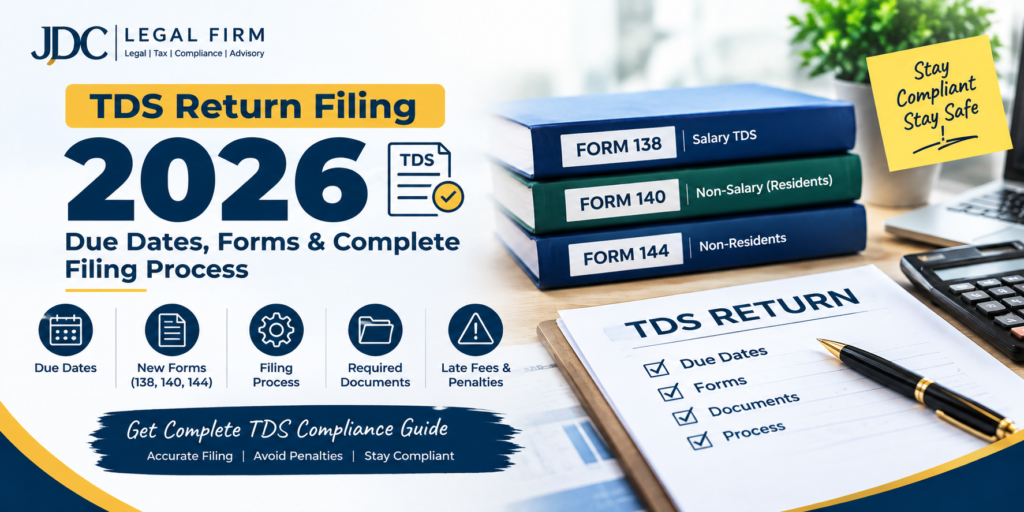
TDS, or Tax Deducted at Source, is an important part of India’s tax compliance system. Businesses, employers, firms, government organisations, and other eligible deductors may be required to deduct tax from specified payments and deposit the amount with the government within the prescribed timeline. They must also report the deduction through the applicable TDS statement.
For 2026, TDS compliance has an important transition because the Income-tax Act, 2025 applies to payments or credits arising on or after 1 April 2026. This means businesses need to understand both the older TDS framework for periods up to 31 March 2026 and the new framework applicable from 1 April 2026. The Income Tax Department has clarified that the applicable law is determined by the earlier of the date of credit or payment.
This guide explains TDS return filing 2026, quarterly due dates, applicable forms, filing requirements, the online filing process, common mistakes, and consequences of delayed compliance.
Quick Answer: What Is the TDS Return Filing Due Date in 2026?
For regular quarterly TDS statements, the standard due dates are:
| Quarter | Period | TDS Statement Due Date |
| Q1 | April to June | 31 July |
| Q2 | July to September | 31 October |
| Q3 | October to December | 31 January |
| Q4 | January to March | 31 May of the following financial year |
These quarterly deadlines apply to the relevant regular TDS statements, including the new Forms 138, 140 and 144 for Tax Year 2026-27 onwards.
For example, for Tax Year 2026-27:
- Q1: April–June 2026 → 31 July 2026
- Q2: July–September 2026 → 31 October 2026
- Q3: October–December 2026 → 31 January 2027
- Q4: January–March 2027 → 31 May 2027
These dates are for filing the quarterly statement. They should not be confused with the separate deadline for depositing TDS deducted during a month.
What Is a TDS Return?
A TDS return, more accurately referred to as a TDS statement, is a periodic statement submitted by a deductor containing details of tax deducted from payments.
The statement generally contains information relating to the deductor, deductees, amounts paid or credited, tax deducted, tax deposited, challan information, and other prescribed details.
The purpose is to allow the tax authorities to reconcile the tax deducted by the payer with the tax reported against the recipient.
For businesses, accurate TDS reporting is therefore important not only for the deductor but also for the deductees who may rely on the reported tax credit.
TDS Return Forms for 2026
One of the most important changes for TDS compliance in 2026 is the introduction of new form numbers under the Income-tax Act, 2025.
Protean’s official TDS/TCS resources identify the following forms for Tax Year 2026-27 onwards: Form 138, Form 140 and Form 144. They correspond broadly to the earlier Forms 24Q, 26Q and 27Q.
Form 138 – Salary TDS
Form 138 is the new form for quarterly reporting of TDS deducted from salary. It was earlier known as Form 24Q.
Employers and other specified deductors responsible for salary-related TDS reporting use this form for the applicable tax year.
The Income Tax Department’s user manual confirms that Form 138 is filed quarterly and follows the standard 31 July, 31 October, 31 January and 31 May schedule.
If your business deducts TDS from employee salaries, payroll records should be reconciled carefully before preparing the quarterly statement.
Form 140 – TDS on Non-Salary Payments to Residents
Form 140 replaces the earlier Form 26Q for relevant periods under the new framework.
It is used for quarterly reporting of TDS on non-salary payments made to residents where TDS is applicable. Examples can include certain payments such as professional fees, commission, brokerage, rent and other specified payments.
The Income Tax Department specifically states that Form 140 is a quarterly statement for TDS on non-salary payments to residents.
Businesses making multiple types of resident payments should maintain accurate records so that the applicable TDS provisions and deductee details are reported correctly.
Form 144 – TDS on Payments to Non-Residents
Form 144 is the new quarterly TDS statement for specified payments other than salary made to non-residents.
It broadly corresponds to the earlier Form 27Q under the previous framework.
The Income Tax Department states that Form 144 is applicable when TDS is deducted from payments such as interest, fees or other income payable to non-residents, subject to the applicable provisions.
International payments require additional care because businesses may need to examine the applicable withholding provisions and documentation before making the payment.
Old TDS Forms vs New TDS Forms in 2026
The transition can be summarised as follows:
| Earlier Form | New Form for Tax Year 2026-27 onwards | Broad purpose |
| Form 24Q | Form 138 | Salary TDS |
| Form 26Q | Form 140 | Non-salary TDS to residents |
| Form 27Q | Form 144 | TDS on specified non-resident payments |
| Form 27EQ | Form 143 | TCS statement |
Protean lists Forms 138, 140, 144 and 143 for Tax Year 2026-27 onwards, while Forms 24Q, 26Q, 27Q and 27EQ remain applicable for earlier periods up to FY 2025-26.
This distinction matters when filing corrections for an older quarter. A correction relating to a period governed by the old Act continues to use the old framework rather than automatically switching to the new form simply because the correction is filed after 1 April 2026. The Income Tax Department has specifically clarified this transition treatment.
Who Needs to File a TDS Statement?
A person responsible for deducting tax at source may have a TDS statement filing obligation for the applicable period.
This can include:
- Companies
- Firms and partnerships
- Employers
- Government organisations
- Certain individuals or other deductors
- Other persons required to deduct TDS under applicable provisions
The exact obligation depends on the payment, deductor, recipient, applicable threshold, and relevant TDS provision.
Therefore, businesses should not assume that every payment automatically requires TDS or that every deductor uses the same form.
TAN Requirement for TDS Filing
A Tax Deduction and Collection Account Number, commonly known as TAN, is an important identifier for persons responsible for deducting or collecting tax at source.
The Income Tax Department’s new TDS form manuals state that the deductor needs a valid TAN registered on the e-Filing portal before filing the relevant TDS form.
Businesses should therefore verify their TAN details before preparing the quarterly statement.
Incorrect TAN information can cause filing or validation problems and may complicate the reconciliation of TDS records.
TDS Deposit Due Date vs TDS Return Due Date
These two deadlines are different.
TDS deposit due date refers to the deadline for depositing tax already deducted with the government.
TDS statement due date refers to the deadline for submitting the quarterly statement reporting the deductions.
Under the Income Tax Department’s current guidance, the general TDS deposit timeline continues to be prescribed through the applicable rules. For non-government deductors, TDS deducted in March is generally deposited by 30 April, while the general monthly timeline is the 7th of the following month, subject to applicable exceptions.
Businesses should therefore maintain a separate compliance calendar for:
- TDS deduction
- TDS deposit
- Quarterly TDS statement
- TDS certificates
- Corrections, if required
Mixing these deadlines is a common compliance mistake.
TDS Return Filing 2026 Process
The filing process for the new TDS forms involves preparation, validation and electronic submission.
Step 1: Determine the Applicable Tax Year
First identify whether the statement relates to:
- A period up to 31 March 2026, governed by the previous framework; or
- A period from 1 April 2026 onwards, governed by the Income-tax Act, 2025.
The date of the earlier event of credit or payment is important in determining the applicable framework.
Step 2: Identify the Correct TDS Form
Select the applicable form based on the nature of payment and recipient.
For Tax Year 2026-27 onwards, the regular TDS forms include:
- Form 138 – salary
- Form 140 – non-salary payments to residents
- Form 144 – specified non-resident payments
Step 3: Collect TDS and Deductee Information
Before preparing the statement, reconcile:
- TAN
- PAN of deductees
- Deductee names
- Amount paid or credited
- Date of payment or credit
- TDS amount
- Applicable TDS provision
- Challan details
- TDS deposit information
Accurate data at this stage can reduce the risk of validation errors later.
Step 4: Prepare the Statement Using RPU
The Income Tax Department’s user manuals refer to the updated Return Preparation Utility, or RPU, available through the Protean portal.
The statement is prepared using the applicable format, validated, and used to generate the required FVU file.
Step 5: Generate and Validate the FVU File
The File Validation Utility, or FVU, checks whether the prepared TDS statement meets the prescribed data structure and validation requirements.
An outdated or mismatched FVU version can result in rejection.
Protean specifically advises users to ensure that the FVU version used matches the version shown on the e-Filing portal.
Step 6: Upload Through the Income Tax e-Filing Portal
After preparing the required file, log in to the Income Tax e-Filing portal using the TAN credentials.
The current process described by the Income Tax Department involves navigating to:
e-File → Income Tax Forms → File Income Tax Forms
Then select the applicable TDS/TCS category, form, tax year, quarter and upload type.
The Form 140 and Form 144 manuals describe this process for the new framework.
Step 7: E-Verify the Filing
After uploading the valid file, the deductor must complete the prescribed verification process.
Once successfully submitted, the form can be viewed under the filed forms section of the portal.
If validation fails, the portal can display a rejection reason that needs to be corrected before resubmission.
Common Reasons for TDS Statement Rejection
TDS statements can be rejected for different data or validation problems.
Common issues identified in the Income Tax Department’s form manuals include:
- Wrong tax year
- Wrong quarter
- Incorrect TAN
- Multiple filings for the same quarter
- Incorrect FVU version
- Uploading a correction file as a regular statement
- Incorrect deductee information
- Incorrect or mismatched correction details
The Form 140 and Form 144 manuals specifically identify these types of rejection reasons.
This is why businesses should reconcile the statement before uploading it rather than treating the filing process as a simple document upload.
What Happens If TDS Return Is Filed Late?
Late filing can result in financial consequences.
For statements governed by the Income-tax Act, 1961, Section 234E provides a late filing fee of ₹200 for every day of default, subject to the statutory ceiling that the fee cannot exceed the amount of tax deductible or collectible.
Other consequences may also arise for incorrect information or failures relating to TDS deduction and deposit.
For 2026, businesses should be careful about which Act governs the particular TDS statement because the consequences and procedural provisions may depend on the relevant tax period.
Interest for Delayed TDS Deduction or Deposit
Late filing and late deposit are different types of defaults.
Under the current Income Tax Department guidance for the new framework, the interest rates for TDS defaults remain aligned with the earlier rates:
- 1% per month or part of a month for failure to deduct or delayed deduction.
- 1.5% per month or part of a month for failure to deposit TDS after deduction.
The Department confirms that the Income-tax Act, 2025 retains these interest rates.
For this reason, businesses should not wait until the quarterly return deadline to check whether monthly TDS deposits have been completed.
TDS Compliance During the 2026 Transition
The 2026 transition is particularly important for businesses with continuing contracts.
The Income Tax Department has clarified that payments or credits occurring on or before 31 March 2026 remain governed by the Income-tax Act, 1961, while payments or credits occurring on or after 1 April 2026 fall under the Income-tax Act, 2025. The relevant trigger is the earlier of payment or credit.
For example, if a professional fee is credited in March 2026 but paid in April 2026, the earlier event is the March credit. Therefore, the old framework applies.
Businesses should review their accounting and payroll systems accordingly. The Income Tax Department has also stated that ERP and payroll systems need to be updated to reflect the new section numbering, terminology and reporting requirements.
Documents and Information Required for TDS Filing
Before preparing a quarterly TDS statement, businesses should generally keep the following information organised, as applicable:
- TAN details
- Deductee PAN
- Deductee name and address
- Payment or credit details
- Date of payment or credit
- TDS amount
- Applicable TDS provision
- Challan details
- BSR or relevant payment information
- Salary information for salary-related statements
- Non-resident payment details where applicable
- Previous filing details
- Correction information, if applicable
The exact data requirements depend on the form and type of transaction.
How Businesses Can Avoid TDS Filing Errors
A good TDS compliance process should begin before the quarterly filing date.
Businesses can reduce avoidable errors by:
Maintain Updated PAN Records
Verify deductee PAN information before preparing the statement. Incorrect PAN details can affect reporting and tax credit.
Reconcile TDS With Accounting Records
The TDS reported in the quarterly statement should be consistent with the underlying books and payment records.
For businesses that need assistance with maintaining financial records, you can also review our Accounting & Bookkeeping Services page for related support.
Reconcile TDS With Challans
Tax deducted and tax deposited should be matched with the relevant challan information before the statement is submitted.
Review the Quarter Before Filing
Do not prepare the return at the last minute. A preliminary review can identify missing deductees, incorrect amounts, duplicate records, or mismatched challans.
Keep Track of Corrections
If an error is discovered after filing, the appropriate correction process should be followed rather than ignoring the mismatch.
TDS and Payroll Compliance
For employers, TDS compliance is closely connected with payroll.
Salary calculations, employee declarations, deductions, PAN details, taxable salary, and TDS deductions need to be reviewed regularly.
Businesses managing a larger workforce may find it useful to coordinate payroll and tax compliance instead of maintaining completely separate processes.
TDS and Income Tax Compliance
TDS is only one component of a business’s broader tax compliance responsibilities.
Businesses may also have income tax, GST, accounting, audit, assessment, notice, and other regulatory requirements depending on their activities.
When Should a Business Take Professional TDS Assistance?
Professional assistance can be particularly useful when a business:
- Has multiple deductees
- Makes different categories of TDS-applicable payments
- Has non-resident transactions
- Receives or responds to TDS-related notices
- Has previous filing errors
- Needs correction statements
- Operates multiple branches or TANs
- Has complex payroll
- Is transitioning its systems for the new 2026 framework
Professional support does not remove the business’s responsibility to provide accurate information. The quality of the final statement depends heavily on the underlying accounting and transaction data.
Frequently Asked Questions
What is the due date for TDS Return Filing in 2026?
The standard quarterly due dates are 31 July, 31 October, 31 January and 31 May for Q1, Q2, Q3 and Q4 respectively. For Tax Year 2026-27, these correspond to 31 July 2026, 31 October 2026, 31 January 2027 and 31 May 2027.
Which form is used for TDS salary returns in 2026?
For Tax Year 2026-27 onwards, Form 138 is used for the quarterly salary TDS statement. It was earlier known as Form 24Q.
Which form replaces Form 26Q?
Form 140 is the new form corresponding to the earlier Form 26Q for applicable non-salary payments to residents.
Which form is used for TDS on non-resident payments?
For Tax Year 2026-27 onwards, Form 144 is used for the applicable quarterly statement of TDS on payments other than salary made to non-residents.
Can old TDS returns still be corrected after April 2026?
Yes. The Income Tax Department has clarified that correction statements relating to periods governed by the Income-tax Act, 1961 continue to follow the old framework even when the correction is filed after 1 April 2026.
Is TDS deposit due date the same as TDS return filing date?
No. TDS deposit and quarterly statement filing are separate compliance requirements. Businesses must track both deadlines independently.
What is the late filing fee for a TDS statement?
For statements governed by the Income-tax Act, 1961, Section 234E provides a fee of ₹200 per day of default, subject to the statutory maximum linked to the amount of tax deductible or collectible.
What should I do if my TDS statement is rejected?
Check the rejection reason shown on the e-Filing portal, correct the underlying data or file format issue, regenerate the required validated file where necessary, and resubmit the statement. The Income Tax Department’s new form manuals list several possible rejection reasons, including incorrect tax year, TAN mismatch, duplicate filing and FVU mismatch.
Conclusion
TDS return filing in 2026 requires more attention than simply remembering the quarterly due dates. The transition to the Income-tax Act, 2025 has introduced new TDS form numbers and reporting processes for Tax Year 2026-27 onwards, while earlier periods continue under the previous framework.
For regular quarterly statements, the key deadlines remain 31 July, 31 October, 31 January and 31 May. Businesses should also separately monitor monthly TDS deposit deadlines, maintain accurate deductee and challan information, reconcile accounting records, and use the correct form and FVU version.
The most important 2026 compliance point is to identify the correct legal framework based on the date of the earlier event of payment or credit. For periods up to 31 March 2026, the previous framework remains relevant; for applicable payments or credits from 1 April 2026 onwards, the new Income-tax Act, 2025 framework applies.